Monthly Archives: March 2011

Grad school is where you go to suck at the only thing you've ever been good at (i.e., school)

Tonight I finished my latest Program of Study. I typed out all the classes I’ve taken, the classes I plan (need) to take, and the time line associated with my Comprehensive exams. As I typed out my short term and long term goals, I couldn’t help but pause and reflect on a few things. What classes excited me despite the challenge? What classes made me feel like this is what I want to do for the rest of my life? What classes will eventually lead to my area of focus for Comps?

Then I thought about why I feel quite different from most of my cohort. Why do I not enjoy writing paper after paper, conducting experiment after experiment, or presenting at conference after conference? Why do I not give a rat’s ass if I ever get my work published? Why do I not go above and beyond what is required of me on an assignment or paper? Why do I feel like I do not belong in this group? I can count on one hand the people to whom I relate most. I still consider the other members of my cohort friends, but we have less in common.

I find more and more these days that my overall goals for grad school do not align with the goals of some other grad students.

Someone in my lab posted this on Facebook (she is also a friend):

Today. On one hand, I did a great job presenting my work in a meeting and it made me feel really good about my intellectual abilities. On the other hand, my thesis is reminding me how much I suck as a person. How very Libra of today.

Someone else in my program replied:

Grad school is where you go to suck at the only thing you’ve ever been good at (i.e., school).

I told my lab mate and friend she is awesome and that in grad school we feel a constant internal tug of war about whether we are good enough. We are expected to be good at ALL of it. When we aren’t, we’re failures.

Then I wrote:

I have to say, school isn’t the one thing I’ve ever been good at and this could explain why I feel like I don’t fit in with everyone. […] I wasn’t great in school. I’d say above average, but not like most of you guys. It’s more like I’m the girl who loved school, but wasn’t super awesome at it.

I sat there looking at what I’d just word vomited onto this person’s Facebook status.

What am I talking about? I WAS great in school. In fact, I was damn great. Sure, I always read slower than the smart kids. I had crippling social anxiety that kept me from excelling in a many ways. I felt like I was always one step behind even though I was always in advanced classes. I don’t have a high IQ. Nope. I score low on standardized tests. On paper, I’m 100% average. AVERAGE. Maybe a little above average, but not by much. I pushed myself because I love learning. I love it so much. Effort. I worked hard. The more I know, the more whole I feel as a human being. Seeking knowledge internally and externally is probably what one would call a passion. It moves me. It fulfills me. It is part of me. Knowledge. I crave it. When I can’t find an answer, I long for it and seek it out to the best of my ability.

When there is no answer? Sometimes, knowing there is no answer is the greatest knowledge of all.

I’m content with the knowledge that I don’t have the answers, but only after I’ve climbed in so deep I can barely find my way out. Then there’s the whole thing where I can’t see black and white. Everything is gray to me. Almost everything. Gray gray gray. I become upset and confused and sometimes angry when people only see one side of a coin. The world is complex. Yes, patterns emerge in the chaos, but ultimately, all this… this Universe… is complex.

Grad school has opened my world and my mind up in so many ways that undergrad and the “real world” never could. There are resources, methods of research, and contacts we just don’t know about until we reach this level of education. (And please remember, I’m talking about Doctoral programs, not any other kind of graduate program when I make these statements.) Without grad school, I wouldn’t even be pursuing a career in Human Factors. I wouldn’t be who I am, where I am today.

So it sounds like I would be the perfect grad student, right?

Not so much.

To come full circle, that quote above?

Grad school is where you go to suck at the only thing you’ve ever been good at (i.e., school).

I don’t feel like this applies to me.

Sometime last semester, I realized this world of academia is not for me.  I feel inadequate more often that not. Even though I am good at presenting my work or teaching other (so I’ve been told), I don’t like it. I’m usually in the bottom of my classes. I don’t enjoy collecting data or sitting in my lab hour after hour running undergraduates through experiments. I don’t eat, breathe, and dream about school. It’s part of my life, part of my day, and it is ultimately a means to an end. I do not identify with most of my fellow grad students. Eventually, I will escape the Ivory Tower. But until I do, I know deep down that I made a commitment to myself and to my goals. I chose to stick with it and I will. It is where I need to be so I can ultimately do the work that will make my heart the happiest. The work that will sustain me.

I have passions beyond school. Some of these passions are related to my studies, but others are not. I can list off the top of my head at least six talents, skills, or abilities I have beyond “being good at school.” I could be using one of those to make a living right now. I will always seek out knowledge. I will always be curious. I will always want to surround myself with other bright, shining, knowledge-seeking individuals. I will always want to make some contribution, something worthwhile and fulfilling.

But I would be willing and able to pay the bills some other way if I had to or chose to. Who I am and what I can contribute to the world goes beyond who I am and what I contribute in grad school or to my field of study. I strongly believe that.

At the end of the day, I want to do the work. I want to take the resources and knowledge I’ve attained in grad school and do the work. Apply it. I’m thankful for those in my program (and in programs around the world) who can ask the tough questions, do research and teach others. I admire those who answer or attempt to answer those wild, imaginative, world changing questions. Without them, I would not be able to ultimately do what I want to do. It’s just not a life I want.

~~~

So, all my grad school friends: Do you feel like you belong? Are you more of an applied person or you do you enjoy the teaching and laboratory research or writing side? Or a combination of these? Do you agree with the quote about grad school being the place where we suck at the one thing we’re good at? Why do you stay? Or why did you go?
Grad school is where you go to suck at the only thing you’ve ever been good at (i.e., school)

Tonight I finished my latest Program of Study. I typed out all the classes I’ve taken, the classes I plan (need) to take, and the timeline associated with my Comprehensive exams. As I typed out my short term and long term goals, I couldn’t help but pause and reflect on a few things. What classes excited me despite the challenge? What classes made me feel like this is what I want to do for the rest of my life? What classes will eventually lead to my area of focus for Comps?

Then I thought about why I feel quite different from most of my cohort. Why do I not enjoy writing paper after paper, conducting experiment after experiment, or presenting at conference after conference? Why do I not give a rat’s ass if I ever get my work published? Why do I not go above and beyond what is required of me on an assignment or paper? Why do I feel like I do not belong in this group? I can count on one hand the people to whom I relate most. I still consider the other members of my cohort friends, but we have less in common.

I find more and more these days that my overall goals for grad school do not align with the goals of some other grad students.

Someone in my lab posted this on Facebook (she is also a friend):

Today. On one hand, I did a great job presenting my work in a meeting and it made me feel really good about my intellectual abilities. On the other hand, my thesis is reminding me how much I suck as a person. How very Libra of today.

Someone else in my program replied:

Grad school is where you go to suck at the only thing you’ve ever been good at (i.e., school).

I told my lab mate and friend she is awesome and that in grad school we feel a constant internal tug of war about whether we are good enough. We are expected to be good at ALL of it. When we aren’t, we’re failures.

Then I wrote:

I have to say, school isn’t the one thing I’ve ever been good at and this could explain why I feel like I don’t fit in with everyone. […] I wasn’t great in school. I’d say above average, but not like most of you guys. It’s more like I’m the girl who loved school, but wasn’t super awesome at it.

I sat there looking at what I’d just word vomited onto this person’s Facebook status.

What am I talking about? I WAS great in school. In fact, I was damn great. Sure, I always read slower than the smart kids. I had crippling social anxiety that kept me from excelling in a many ways. I felt like I was always one step behind even though I was always in advanced classes. I don’t have a high IQ. Nope. I score low on standardized tests. On paper, I’m 100% average. AVERAGE. Maybe a little above average, but not by much. I pushed myself because I love learning. I love it so much. Effort. I worked hard. The more I know, the more whole I feel as a human being. Seeking knowledge internally and externally is probably what one would call a passion. It moves me. It fulfills me. It is part of me. Knowledge. I crave it. When I can’t find an answer, I long for it and seek it out to the best of my ability.

When there is no answer? Sometimes, knowing there is no answer is the greatest knowledge of all.

I’m content with the knowledge that I don’t have the answers, but only after I’ve climbed in so deep I can barely find my way out. Then there’s the whole thing where I can’t see black and white. Everything is gray to me. Almost everything. Gray gray gray. I become upset and confused and sometimes angry when people only see one side of a coin. The world is complex. Yes, patterns emerge in the chaos, but ultimately, all this… this Universe… is complex.

Grad school has opened my world and my mind up in so many ways that undergrad and the “real world” never could. There are resources, methods of research, and contacts we just don’t know about until we reach this level of education. (And please remember, I’m talking about Doctoral programs, not any other kind of graduate program when I make these statements.) Without grad school, I wouldn’t even be pursuing a career in Human Factors. I wouldn’t be who I am, where I am today.

So it sounds like I would be the perfect grad student, right?

Not so much.

To come full circle, that quote above?

Grad school is where you go to suck at the only thing you’ve ever been good at (i.e., school).

I don’t feel like this applies to me.

Sometime last semester, I realized this world of academia is not for me.  I feel inadequate more often that not. Even though I am good at presenting my work or teaching other (so I’ve been told), I don’t like it. I’m usually in the bottom of my classes. I don’t enjoy collecting data or sitting in my lab hour after hour running undergraduates through experiments. I don’t eat, breathe, and dream about school. It’s part of my life, part of my day, and it is ultimately a means to an end. I do not identify with most of my fellow grad students. Eventually, I will escape the Ivory Tower. But until I do, I know deep down that I made a commitment to myself and to my goals. I chose to stick with it and I will. It is where I need to be so I can ultimately do the work that will make my heart the happiest. The work that will sustain me.

I have passions beyond school. Some of these passions are related to my studies, but others are not. I can list off the top of my head at least six talents, skills, or abilities I have beyond “being good at school.” I could be using one of those to make a living right now. I will always seek out knowledge. I will always be curious. I will always want to surround myself with other bright, shining, knowledge-seeking individuals. I will always want to make some contribution, something worthwhile and fulfilling.

But I would be willing and able to pay the bills some other way if I had to or chose to. Who I am and what I can contribute to the world goes beyond who I am and what I contribute in grad school or to my field of study. I strongly believe that.

At the end of the day, I want to do the work. I want to take the resources and knowledge I’ve attained in grad school and do the work. Apply it. I’m thankful for those in my program (and in programs around the world) who can ask the tough questions, do research and teach others. I admire those who answer or attempt to answer those wild, imaginative, world changing questions. Without them, I would not be able to ultimately do what I want to do. It’s just not a life I want.

~~~

So, all my grad school friends: Do you feel like you belong? Are you more of an applied person or you do you enjoy the teaching and laboratory research or writing side? Or a combination of these? Do you agree with the quote about grad school being the place where we suck at the one thing we’re good at? Why do you stay? Or why did you go?

Read Across America

“You may not see it now,” said the Princess of Pure Reason, looking knowingly at Milo’s puzzled face, “but whatever we learn has a purpose and whatever we do affects everything and everyone else, if even in the tiniest way. Why, when a housefly flaps his wings, a breeze goes round the world; when a speck of dust falls to the ground, the entire planet weighs a little more; and when you stamp your foot, the earth moves slightly off its course. Whenever you laugh, gladness spreads like the ripples in the pond; and whenever you’re sad, no one anywhere can be really happy. And it’s much the same thing with knowledge, for whenever you learn something new, the whole world becomes that much richer.”

A couple days ago Jeremy asked if I would participate in Read Across America. This is the third year he’s asked people to call in via Skype and read something to his class. You probably know some of the others who are reading to his class today. Isn’t this a great idea?! I love it.

Today is also Dr. Seuss‘s birthday.

I had a hard time deciding what to read because most of my children’s books are in my mom’s attic in Rubbermaid containers. Also, at 10 years old I was reading at higher grade levels. This is somewhat surprising given my difficulties with reading. I read to myself like I would read aloud, so I’m a slow reader. I also switch words around (it’s the same with numbers). As a kid I also had severe anxiety and hated reading aloud in class because of those issues. I started thinking about this when I said I would read to Jeremy’s class. What if I screw it up? What if I switch the words around? I’m almost 28 years old and I got nervous thinking about reading in front of some kids! But I love reading. I always have. My frustrations and inability to read quickly never kept me from reading everything I could get my hands on.

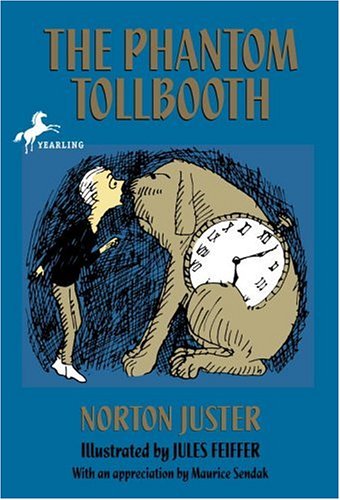
I wanted to read some Neil Gaiman to Jeremy’s class, but the lovely Grace beat me to it. I chose not to read a Dr. Suess story because I didn’t really like Dr. Suess as a ten year old. Instead, I’m reading the first two chapters from one of my top ten favorite books of all time. It is a book that my mom read to me as a kid and one I read every few years because it is so remarkable. It was enjoyable to read as a kid, but I thought it was brilliant by high school. I still have my mom’s copy from when she was a kid. Maybe after hearing the first section, they’ll want to finish the story themselves or to ask a family member to read it to them.

{Image via Britannica.com}

It’s about a ten year old boy, Milo, who is bored with everything. After a tollbooth lands in his bedroom, he travels to a far off world filled with topsy turvy places like Digitopolis, Dictionopolis and the Doldrums. He meets some wonderful characters like Tock the watchdog who hates killing time, the Humbug who is a bug with nothing very positive to say, and the Spelling B-e-e who is, yes, a bee and an expert speller. They encounter terrible villains like the Senses Taker, the Trivium, and the Lethargians. They must rescue Rhyme and Reason in the Castle in the Air because there is a disagreement about whether numbers or letters are more important than one another. Along the way, a conductor conducts a sunrise, they don’t get wet in the Sea of Knowledge, a midget is actually a giant depending on how you look at it, people eat their words (and synonym buns), and the Whether Man doesn’t care what the weather is as long as he knows whether there will be weather. In the end, Milo comes to appreciate learning, curiosity, and perspective, and he is never bored again. Yeah, so it’s completely fantastical, but it is so clever and has a great message.

Books like this made me love reading. And love learning. It’s amazing how the lessons we learn as children can stick with us into adulthood.

“And remember, also,” added the Princess of Sweet Rhyme, “that many places you would like to see are just off the map and many things you want to know are just out of sight or a little beyond your reach. But someday you’ll reach them all, for what you learn today, for no reason at all, will help you discover all the wonderful secrets of tomorrow.”

Norton Juster Norton Juster > quotes


See if your friends have read any of Norton Juster’s books.

Sign up »


“Expect everything, I always say, and the unexpected never happens.”
Norton Juster (The Phantom Tollbooth)
“…the most important reason for going from one place to another is to see what’s in between, and they took great pleasure in doing just that.”
Norton Juster (The Phantom Tollbooth)
“Time is a gift, given to you, given to give you the time you need, the time you need to have the time of your life. ”
Norton Juster (The Phantom Tollbooth)
“You may not see it now,” said the Princess of Pure Reason, looking knowingly at Milo’s puzzled face, “but whatever we learn has a purpose and whatever we do affects everything and everyone else, if even in the tiniest way. Why, when a housefly flaps his wings, a breeze goes round the world; when a speck of dust falls to the ground, the entire planet weighs a little more; and when you stamp your foot, the earth moves slightly off its course. Whenever you laugh, gladness spreads like the ripples in the pond; and whenever you’re sad, no one anywhere can be really happy. And it’s much the same thing with knowledge, for whenever you learn something new, the whole world becomes that much richer.”
Norton Juster (The Phantom Tollbooth)
“The only thing you can do easily is be wrong, and that’s hardly worth the effort”
Norton Juster (The Phantom Tollbooth)
“…it’s not just learning that’s important. It’s learning what to do with what you learn and learning why you learn things that matters.”
Norton Juster
“Things which are equally bad are also equally good. Try to look at the bright side of things.
– Humbug”
Norton Juster (The Phantom Tollbooth)
“You can swim all day in the Sea of Knowledge and not get wet.”
Norton Juster (The Phantom Tollbooth)
“It has been a long trip,” said Milo, climbing onto the couch where the princesses sat; “but we would have been here much sooner if I hadn’t made so many mistakes. I’m afraid it’s all my fault.”
“You must never feel badly about making mistakes,” explained Reason quietly, “as long as you take the trouble to learn from them. For you often learn more by being wrong for the right reasons than you do by being right for the wrong reasons.”
Norton Juster (The Phantom Tollbooth)
“Everybody is so terribly sensitive about the things they know best.”
Norton Juster (The Phantom Tollbooth)
“Would it be possible for me to see something from up there?” asked Milo politely.”You could,” said Alec, “but only if you try very hard to look at things as an adult does.”Milo tried as hard as he could, and, as he did, his feet floated slowly off the ground until he was standing in the air next to Alex Bings. He looked around very quickly and, an instant later, crashed back down to the earth again.”Interesting, wasn’t it?” asked Alex.

“Yes, it was,” agreed Milo, rubbing his head and dusting himself off, “but I think I’ll continue to see things as a child. It’s not so far to fall.”
Norton Juster (The Phantom Tollbooth)

“A slavish concern for the composition of words is the sign of a bankrupt intellect. Be gone, odious wasp! You smell of decayed syllables.”
Norton Juster (The Phantom Tollbooth)
“For instance,” said the boy again, “if Christmas trees were people and people were Christmas trees, we’d all be chopped down, put up in the living room, and covered in tinsel, while the trees opened our presents.”
“What does that have to do with it?” asked Milo.
“Nothing at all,” he answered, “but it’s an interesting possibility, don’t you think?”
Norton Juster (The Phantom Tollbooth)
“Whether or not you find your own way, you’re bound to find some way. If you happen to find my way, please return it, as it was lost years ago. I imagine by now it’s quite rusty.”
Norton Juster (The Phantom Tollbooth)
“As the cheering continued, Rhyme leaned forward and touched Milo gently on the shoulder.
“They’re cheering for you,” she said with a smile.
“But I could never have done it,” he objected, “without everyone else’s help.”
“That may be true,” said Reason gravely, “but you had the courage to try; and what you can do is often simply a matter of what you *will* do.”
“That’s why,” said Azaz, “there was one very important thing about your quest that we couldn’t discuss until you returned.
“I remember,” said Milo eagerly. “Tell me now.”
“It was impossible,” said the king, looking at the Mathemagician.
“Completely impossible,” said the Mathemagician, looking at the king.
“Do you mean—-” said the bug, who suddenly felt a bit faint.
“Yes, indeed,” they repeated together; “but if we’d told you then, you might not have gone—and, as you’ve discovered, so many things are possible just as long as you don’t know they’re impossible.”
And for the remainder of the ride Milo didn’t utter a sound.”
Norton Juster (The Phantom Tollbooth)
“It’s bad enough wasting time without killing it.”
Norton Juster (The Phantom Tollbooth)
“The most important reason for going from one place to another is to see what’s in between.”
Norton Juster (The Phantom Tollbooth)
“So many things are possible just as long as you don’t know they’re impossible.”
Norton Juster (The Phantom Tollbooth)
“You must never feel badly about making mistakes … as long as you take the trouble to learn from them. For you often learn more by being wrong for the right reasons than you do by being right for the wrong reasons.”
Norton Juster (The Phantom Tollbooth)
“Let me try once more,” Milo said in an effort to explain. “In other words–”
“You mean you have other words?” cried the bird happily. “Well, by all means, use them. You’re certainly not doing very well with the ones you have now.”
Norton Juster (The Phantom Tollbooth)

“And remember, also,” added the Princess of Sweet Rhyme, “that many places you would like to see are just off the map and many things you want to know are just out of sight or a little beyond your reach. But someday you’ll reach them all, for what you learn today, for no reason at all, will help you discover all the wonderful secrets of tomorrow.”