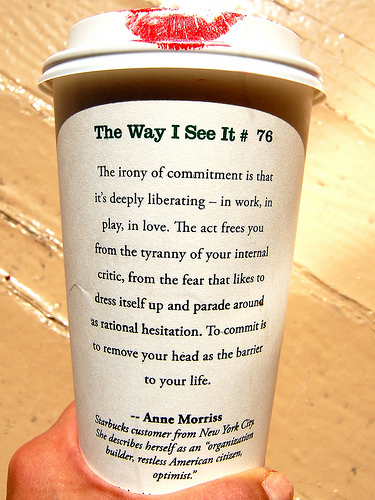
This is the first week of class. With my syllabi in hand, I did my best to coordinate schedules and duties for my courses, student organizations, work, and teaching assistantship. I tried to organize my calendar in such a way that I have time for myself, my friends, my health and my hobbies. I made a list of all the things I should do and discovered many of my thoughts were contradictory or at the very least impossible to achieve.
- I should lose 30 pounds.
- I should do more research to boost my Vita.
- I should be more organized.
- I should clean more often.
- I should be better with staying on top of everything and everyone online.
- I should start paying back my loans now.
- I should spend less on groceries.
- I should go to yoga more often.
- I should spend more time studying.
- I should move now to maintain my sanity, but I should wait a month to appease my family.
- I should I should I should I should I should…
You get the idea. Somewhere in all that thinking and all that “shoulding,” I remembered something a friend said to me last week.
Remove the word “should” from your vocabulary.
Some definitions of should: past tense of shall; must; ought; would. Some definitions of shall: plan to, intend to, or expect to; will have to, is determined to, or definitely will; must;is or are obliged to.
I did a little digging in some of my psychology textbooks and online. A“should statement“ is one of the ten cognitive distortions within the framework of Cognitive Therapy. There is some discrepancy about who coined the phrase “stop shoulding on yourself” first, Clayton Barbeau or Albert Ellis. Ellis is a founding father of cognitive-behavioral therapy (CBT) and also calls it “musterbation.” CBT is, in my opinion, the most effective form of therapy and one with which I am very familiar.
They are not talking about cost-benefit analyses or times when we rationally weigh our options to decide which obligation is healthiest. They are talking about automatic, guilt- and anxiety-inducing thoughts about obligations we place on ourselves or obligations we believe society, family, friends, etc. place on us. These are the kinds of thoughts that might lead to negative self-talk and procrastination because they induce anxiety and negative affect. One goal of cognitive therapy is to eliminate and remove these types of distortions from our cognitive blueprint via a process called cognitive restructuring.
Lisa Martin – Stop Shoulding on Yourself:
Shoulds get in the way. They stop you from doing what you really want – what is important to you. Living your life based on shoulds takes you away from your true purpose. It can make you feel miserable and out of balance.
Peter G. Vajda – I should, no I choose
The antidote to should is “I choose.” When we change our internal script from “should” to “choose”, we take ownership of our actions. We are in charge; we are in control. The energy underneath “I choose” is empowering and freeing – even if I choose “not to be” or “not to do”. Since I am making the choice, even when I choose “not to”, the burden of guilt has been lifted. I am indebted to no one, but myself. That “inner judge and critic” that wags its finger and shakes its critical and judgmental head when I don’t do what I “should” is now silent, almost nonexistent. Freedom and lightness arise.
I choose to stop shoulding on myself
Many of the “shoulds” in my life revolve around others’ expectations, needs and desires or they revolve around what I think others expect from me. I feel guilty for not being a better friend, grand-daughter, sister, blogger, student, worker, lab mate, researcher, etc. I take on too many roles and try to be everything for everyone and sometimes I lose myself. I am human, nothing more. I do not want to be perfect because I know my desire for perfection in the past held me back from truly living my life. Why do I continue to try to make everyone happy instead of taking care of myself?
This semester is going to be tough and I want to be successful in finding balance in my life. To be successful in anything I want to accomplish for myself, I choose to reduce the number of times I think I should do or be something. Most importantly, I choose to focus on the things that will bring me closer to my bigger life goals. Right now, I choose to focus on school.
Image via YATL